
Contact — Pure Casino Australia Review | Support Case Guidance
Contact the Pure Casino review desk with payout timelines, KYC evidence, and support-case details for clear, actionable escalation.
Read the full Pure Casino review: go back to the main page before making deposit or withdrawal decisions.
📨 Best support tickets are short, structured, and timestamped. One clean thread beats five fragmented chats.
How to contact this review team
📨 What to include in your message
If you submit a case, include payment method, requested amount, ticket ID, and a short timeline from request creation to current status. Add screenshots only when they clarify a concrete event. This helps us distinguish term issues from technical issues and queue-related delays. Messages that contain complete context can be assessed quickly and receive better guidance. Fragmented messages usually trigger back-and-forth loops that cost time for both sides.
⏱️ When escalation is appropriate
Escalate after stated windows are exceeded and you can provide evidence in one structured thread. Premature escalation without context tends to slow resolution because support teams first need to reconstruct missing history. We recommend preserving chat logs, email headers, and request timestamps before raising severity. This creates accountability markers and makes follow-up measurable. If you are unsure, start with a concise timeline and we will suggest the next clean step.
Support readiness checklist
✅ Before first cashout request
Confirm profile details match your payment ownership, ensure document scans are readable, and avoid changing methods mid-cycle. These basic controls reduce review friction significantly. Many “slow payout” cases start with preventable mismatches rather than operator refusal. The best time to fix this is before the first withdrawal, not after it enters pending status. A two-minute pre-check often saves multi-day delays.
🧭 Useful links for self-help
Before opening a new case, review FAQ, bug playbook, and support section. These sections cover the most common failure patterns and provide ready-to-use templates. In many situations, one corrected message with full context resolves what looked like a serious dispute. This approach reduces emotional messaging and protects your own evidence chain.
Escalation with evidence
📎 Ticket quality standard
A high-quality escalation includes method, amount, timestamps, and one clear expected outcome. Add the exact point where workflow diverged from stated policy, then ask a binary follow-up question. This format improves response quality because it forces an actionable answer instead of generic reassurance. Keep your language neutral and precise. Clarity outperforms intensity in almost every support environment.
🚫 How to avoid support dead-ends
Never run the same case across multiple channels at once unless instructed. Parallel threads create contradictory logs and weaken your leverage. Keep one canonical thread, update it with new facts, and request named next actions with ETA. If ETA passes, reference it directly and ask for escalation level. This keeps pressure professional and makes progress auditable.
Contact policy and response scope
🧩 What we can and cannot do
We can help you structure evidence, improve message quality, and choose the right escalation step. We cannot override casino decisions, process payments, or access your account records. Our role is to improve your decision quality and reduce avoidable communication errors. That boundary keeps guidance practical and trustworthy. If legal concerns arise, we can point you toward formal channels, but we are not a legal service.
🔁 Follow-up rhythm that works
Use disciplined follow-up intervals instead of rapid-fire pings. A well-timed update every defined window with new evidence is stronger than repeated “any update?” messages. This pattern keeps your case visible without creating noise. It also helps future review and dispute handling because your record remains coherent. Consistency wins over urgency theatre.
Message templates that save time
📝 First contact template
Start with one concise block: account context, payment method, amount, request timestamp, and desired action. Then add one attachment set with clear filenames. Avoid story-like narration in the first message; chronology and precision are more useful. A structured first contact often prevents three rounds of clarification and gives support a cleaner path to ownership.
📌 Follow-up template after SLA drift
If the promised window is exceeded, reference the original timestamp and ask for one explicit next step with ETA. Keep wording factual and short. Example pattern: “Request created at X, expected window Y, current status Z, please confirm next action and expected completion.” This format reduces generic replies and invites accountable updates.
Escalation hygiene for disputed payouts
⚖️ Evidence ordering strategy
Order your evidence in timeline sequence: deposit proof, wager completion proof, withdrawal request, and support interactions. Unordered evidence makes even valid cases harder to parse. In escalation contexts, readability is leverage. A clearly ordered record helps reviewers identify the exact break-point faster and lowers the risk of “insufficient information” loops.
🧠 Emotional control during support loops
Support deadlocks often trigger emotional writing, which weakens clarity. Use a fixed routine instead: pause, update timeline, ask one clear question, and wait the defined interval. This keeps your case coherent and protects your own decision quality. Calm structure does not guarantee instant resolution, but it consistently improves the odds of actionable responses.

Operational Chart
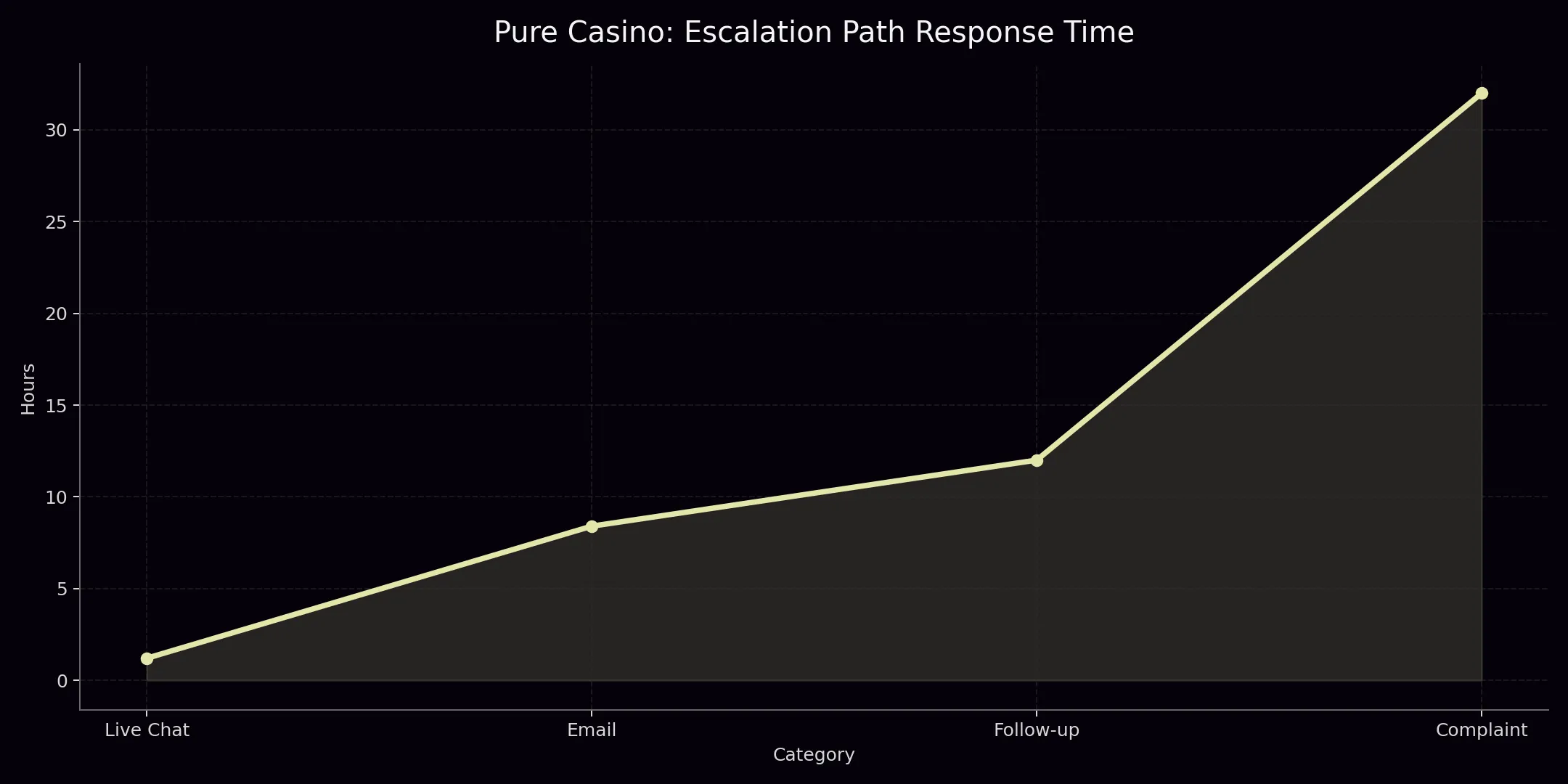
This chart shows typical response-time layers across initial contact, follow-up, escalation, and resolution checkpoints. It helps set realistic expectations so players do not overreact too early or wait too long. The practical value is timing discipline: send complete evidence first, then follow a clear escalation rhythm. Cases with strong chronology usually resolve faster. Use this graph to pace your communication and keep leverage professional.